
Why streak counters make quitting porn harder
One bad night turns day 40 into day 0. The reset, the shame and the binge that follows, and what to measure instead.
By the rerute team4 min readUpdated

the short answer
A streak measures one thing: days since your last slip. When the slip comes, months of real change get displayed as zero, and that sudden loss feels like failure. Feeling like a failure is one of the most reliable routes back to the screen, because the thought "I've blown it" makes the next session easier to justify. Tracking what you've built, rather than how long you've gone without, removes that cliff.
What a streak actually measures
A streak counts days since your last slip. That's all. It doesn't know how many urges you outlasted, whether your triggers are losing their grip, or how much calmer your evenings are. It only knows whether yesterday was perfect.
So when someone at day 40 has one bad night, the counter shows 0. Forty days of real change are still there, in their brain and in their routines. The screen says they're gone.
The cliff and the binge
That reset hurts, and the hurt has consequences. Relapse researchers describe the abstinence violation effect: when someone committed to total abstinence slips, they tend to blame it on a personal failing and conclude the whole effort was pointless. Guilt plus "it's already ruined" makes continued use more likely. One session becomes a weekend.
A day counter is close to a machine for producing that effect. It defines success as an unbroken line, so any break is total. And the bigger the number, the higher the cliff.
The longer the streak, the further you fall from it.
Shame doesn't keep you clean
The streak's unspoken promise is that the fear of losing it will hold you back. Fear and shame feel like they should work. The evidence points the other way. In a study of people in early recovery from alcohol problems, those who displayed more shame while describing their last drink relapsed more often, and their health declined more over the following months. Shame is a hiding feeling, and hiding is where the old road lives. More on shame.
Streaks keep porn at the center
There's a quieter cost too. A streak makes not watching porn the main event of every day. You check the number, protect it, think about it. Your attention stays exactly where you're trying to move it away from.
It also implies a finish line: day 30, day 90, day 365, as if something switches over and then you're done. Nothing switches over on day 90. Waiting for it makes the days before feel like a sentence and the day after feel like permission. Habit research suggests new routines take anywhere from a few weeks to most of a year to become automatic, with no single day that flips them.
Some people like their streak
That's fair. A number going up can feel good, and for some people it's motivating for a while. The problem isn't the encouragement. It's what happens on the day it breaks, and for most people it breaks at some point. A measure of progress should survive a bad night.
What to measure instead
Measure what you're building, not how long you've gone without:
- Urges outlasted. Each one you ride out weakens the old pathway. That's progress you keep.
- Where and when urges hit. Patterns in your hours, places and moods tell you where your rules should go.
- What led to a lapse. The first small step is the most useful information you'll get.
- How far you are from the old pattern, rather than how long since the last slip.
How rerute does it
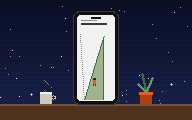
rerute has no day counter. Your recovery is drawn as a road beside the old one. Each clean day carries it a little further out, and the urges you outlast leave stones on it. A lapse bends the road back toward the old one by a few days, more for a longer session, and the old road glows while its pull is strongest. Ground you've already walked comes back twice as fast, so after a single lapse you're usually back where you were within two to eight days. Milestones you've passed stay passed.
The point isn't to soften the truth. A lapse does cost you something. It just doesn't cost you everything, and the display says so. See the road.
Questions people ask
Are streak counters bad for porn recovery?
For many people they backfire. They make every day a test and one slip look like total failure, which feeds the shame-and-binge cycle. Some people find them motivating early on, but the reset is where the damage happens.
What should I track instead of a streak?
Track what you're building and what you're learning: urges you outlasted, the hours and places they hit, and what led up to any lapse. That turns every day, including the bad ones, into useful information.
Why does my streak make me want to relapse?
A long streak becomes something to protect, which keeps porn at the center of your attention. And as the number grows, a slip starts to feel catastrophic, so one slip easily turns into "might as well".
sources
- Larimer, M. E., Palmer, R. S., & Marlatt, G. A. (1999). Relapse prevention: an overview of Marlatt's cognitive-behavioral model. Alcohol Research & Health, 23(2), 151–160. pubmed.ncbi.nlm.nih.gov/10890810
- Marlatt, G. A., & Gordon, J. R. (Eds.) (1985). Relapse Prevention: Maintenance Strategies in the Treatment of Addictive Behaviors. Guilford Press.
- Randles, D., & Tracy, J. L. (2013). Nonverbal displays of shame predict relapse and declining health in recovering alcoholics. Clinical Psychological Science, 1(2), 149–155. doi.org/10.1177/2167702612470645
- Lally, P., van Jaarsveld, C. H. M., Potts, H. W. W., & Wardle, J. (2010). How are habits formed: modelling habit formation in the real world. European Journal of Social Psychology, 40(6), 998–1009. doi.org/10.1002/ejsp.674
Written and reviewed by the rerute team. rerute is a self-help tool, not medical advice or treatment. If your porn use is tangled up with depression, trauma or thoughts of harming yourself, talk to a professional. If you're in danger, contact your local emergency number.